
As the semester gets underway, we want to make sure you’re receiving the benefits and protections guaranteed by our collective bargaining agreement. Read on for updates about paid professional development leaves, anti–bullying protections, fair reappointment and promotion procedures, and strong shared governance.
You’ll notice one common theme: Don’t assume that the NYU administration is implementing our contract correctly or fairly — when changes are announced, check them against the language in our collective bargaining agreement, and get in touch immediately if you notice anything that concerns you.
Paid Professional Development Leaves
In Article 20, we won a handful of paid professional development leaves (a.k.a. sabbaticals), to be distributed on the basis of seniority to people who have not previously taken a sabbatical or similar paid research or professional development leave. Tisch and Gallatin faculty are not eligible for these leaves because our contract guarantees continued eligibility for sabbaticals offered in these schools, along with other competitive paid leaves that pre-date the CBA.
If you’ve been working at NYU for more than six years in a school other than Tisch or Gallatin and have not taken a sabbatical or similar paid research or development leave in the last six years, you can apply to take a paid professional development leave in AY 2027-28. Read Article 20 to learn more about the process, and let your chair know you’re interested in applying by October 15, 2026.
Protections against Bullying
At a time when civil rights are under national attack, Article 26 (Respectful Work Environment) creates important new protections, including partial protection against caste discrimination; guarantees of disability, pregnancy, lactation, and religious accommodations, and a commitment that contract faculty members may use, and have others use, their preferred names and pronouns.
For decades, NYU faculty, staff and students fought for real protections against power-based harassment. We should be proud that we used our contract negotiations to force the administration to adopt a university-wide anti–bullying policy. This is a victory for everyone at NYU — and, because the anti–bullying policy is enshrined in our contract, we have an additional layer of protection.
If you are a victim of bullying as defined in the policy — by a colleague, by a dean, or by anyone else — you don’t need to make the report to your chair, your dean, or your school’s HR department. As a union member, you can let a steward or a rep know you need support; we’ll guide you through the grievance process and help you defend your rights.
Reappointment & Promotion Process
Another major victory in our contract is that NYU contract faculty have presumption of renewal following their second reappointment. If you’ve gone up for review at least twice, you never again need to prepare a lengthy dossier just to keep your job. The administration can’t ask you to request or apply for reappointment, or to submit any additional materials.
If you’re up for promotion or still on your first or second appointment (and thus not yet presumptively renewable), the review process will be somewhat different but mostly familiar. Articles 4 (Appointment and Reappointment) and 25 (Promotion) preserve peer review committees, although they might take a different form. Article 21 (Performance Evaluation) creates a system for integrating the school-, program-, and department-level reappointment and promotion criteria developed through shared governance into our collective bargaining agreement. Chairs and deans have to follow the criteria listed in Article 21; any addition to or explication of those criteria must go through the process described in Section 6.
Since school procedures are currently in flux as the administration figures out how to implement the contract, we all need to be on guard and to pay attention. If your chair or dean announces changes “to comply with the CFU contract,” don’t take their word for it — read Articles 4, 21, and 25 and check their work against our contract language. Reply to this email if you suspect that your local administration is doing anything sketchy.
Shared Governance
Article 29, which guarantees our continued participation in shared governance, was one of the last things we won in our strike. The terms and conditions of our employment are now resolved through collective bargaining, rather than through shared governance — but our contract clearly states that “New York University recognizes that Contract Faculty Members shall be regarded as full members of the faculty and will continue to participate in shared governance in the University Senate, the C-FSC, and alongside other full-time faculty at the University, school, college, and department levels on matters of academic and pedagogical concern to the University and its schools, colleges, and departments.” The only committees from which we may be excluded are those “that primarily address the financial affairs of the University or its schools, colleges, or departments, or that primarily address the terms and conditions of employment of Contract Faculty Members or any other employees.”
This means that the vast majority of committee work should proceed as usual, including search committees. Both Article 4 and Article 29 make clear that contract faculty can continue to serve on hiring committees, just as we did before our contract was ratified. Remember also that Article 36 guarantees our right to engage in service “according to [our] expertise and professional judgment.” This form of academic freedom applies in faculty meetings, committees, and anywhere else where you perform service; we can help you defend it with a grievance.
If you learn about changes to shared governance in your school or department “to comply with the CFU contract,” read Article 29, and make sure your dean or chair reads it too. Contract faculty are not supposed to participate in decision-making about university or school finances, or about terms and conditions of employment — if your dean or chair is attempting to make broader changes that erode shared governance and marginalize contract faculty, let us know immediately.
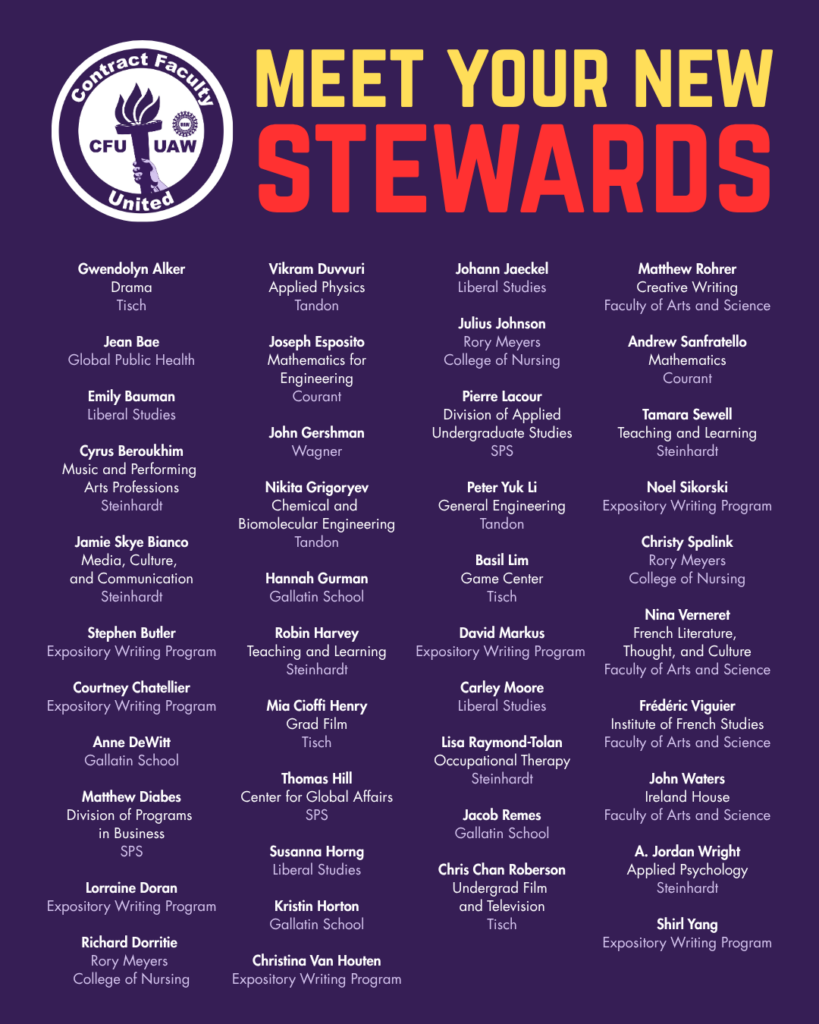
The best advice we can offer you is to read the contract you won last spring and to learn your rights and benefits, so you’re able to recognize contract violations and respond appropriately. When in doubt, get in touch: CFU stewards and reps can help you understand the grievance process and work with you to defend what we’ve won.
In solidarity,
Elisabeth Fay | Unit Chair
Gwendolyn Alker, Dustin Jones, Gerard O’Donoghue, Benedetta Piantella, and Jamie Root | Unit Representatives