
Watch Robin Harvey (Steinhardt) and Ger O’Donohue (FAS) describe Tuesday’s bargaining session.
Today’s update:
-
Big distance on fair pay and shared governance: attend an escalation workshop
-
Coming closer where we’ve exerted big pressure: observe bargaining now
-
We’re making gains for everyone at NYU: tell your colleagues
Tuesday was our 20th bargaining session with the NYU administration, and it finally seems they’re feeling some pressure. While we are still very far apart on a lot of core demands — parity with tenure-track faculty, pay and benefits that reflect our contributions to NYU, salary equity, academic freedom, shared governance, peer review — the administration came closer to us in meaningful ways on other demands.
See every proposal and counterproposal on the bargaining tracker.
Still Far Away
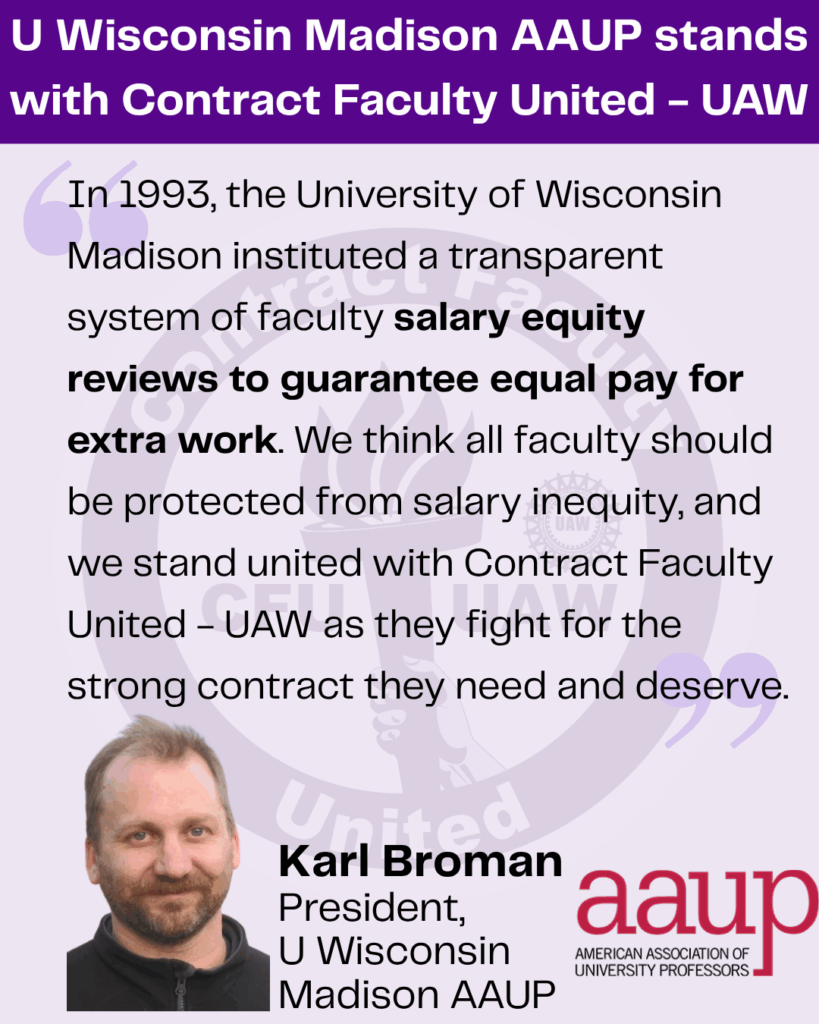 Our demands on salary have always been clear: we need salaries that reflect our contribution to NYU. This means substantially raising minimum salaries, fixing salary compression and stagnation, solving the substantial pay gap by sex and race, and ensuring that our average salary is at parity with the average salary of our tenure-track colleagues. We presented a thorough report and replicable statistical analysis that showed the disconcerting salary gap by sex and race: at NYU, women make almost 10% less than men, faculty of color make 93 cents on the white male dollar, and this gap is worst for women of color, who make 87 cents on the white male dollar. We reasserted our proposal, based on a system first implemented at the University of Wisconsin-Madison in 1993, for a fair and transparent salary equity review system to solve this problem. We also gave the administration a counter on 12-month contracts that would give everyone on 12-month contracts the right to switch to a 9-month schedule and raise the salaries of the most underpaid 12-month faculty who prefer to stay year-round.
If we are still fighting to make the administration respect and pay for our professional contributions, we are also still fighting for conditions and funding that will let us grow those contributions. We presented counterproposals on Sabbaticals (where we continue to demand parity with tenure-track colleagues) and Individual Development Accounts. The administration is much closer to us on the former than the latter, but we still need them to take us seriously as professionals and academics — both in supporting our scholarly, artistic, and pedagogical practices and in our right to make free academic decisions about who teaches what to whom, how.
We continue to demand that academics like us make academic decisions — and unfortunately the administration continues to reject that basic tenet of the American university system. On Tuesday they brought a counterproposal on Grievance and Arbitration, where they still insisted on cutting out peer review from the process of grievances related to reappointment and promotion. The administration’s attacks on shared governance and peer review and their refusal to agree to strong academic freedom provisions remain a major sticking point.
Coming Closer
 For the past several weeks, contract faculty across the university have been coming together in person and on zoom to talk about the next steps to win the contract we need and deserve. (It’s not too late to join an escalation workshop!) Colleagues have also been turning out in high numbers to observe bargaining. And the administration has taken notice. They came closer to us on some important issues, including:
-
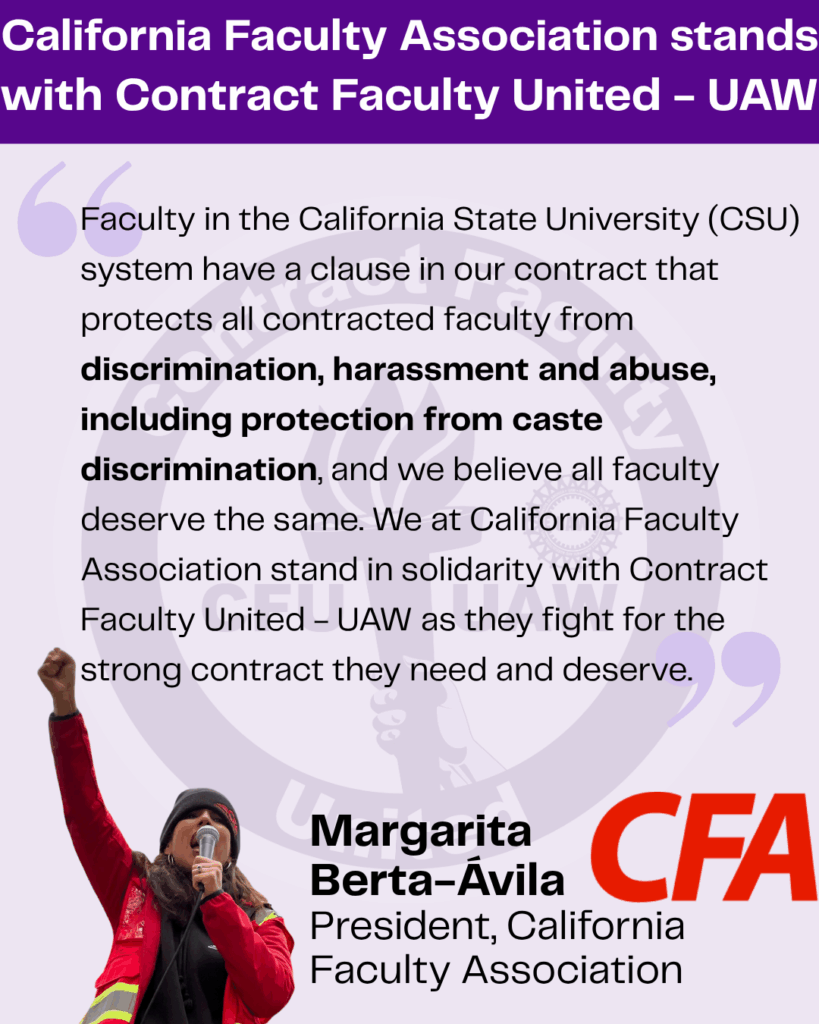
Respectful Work Environment, where they are finally negotiating over protections against caste discrimination and bullying.
-
Health insurance, where they agreed for the first time to guarantee that our coverage won’t get worse and to limit premium increases.
-
Child Care, where they finally acknowledged that the status quo is inadequate and proposed a child care fund.
-
International Faculty Members, where they agreed to increase the financial support for non-citizen colleagues’ immigration expenses, but still have not agreed to sponsor them for green cards.
-
Leaves of Absence, where we won the major victory that if two caregivers in the same family work for NYU, they will both be eligible for family bonding workload relief (current policy requires that they share one leave!). They also agreed to more generous bereavement leave (and, as discussed below, have extended that to everyone else).
In all these cases, there’s still a lot of distance to go, but the administration has begun to listen.
RSVP to observe bargaining December 18
Wins for Everyone
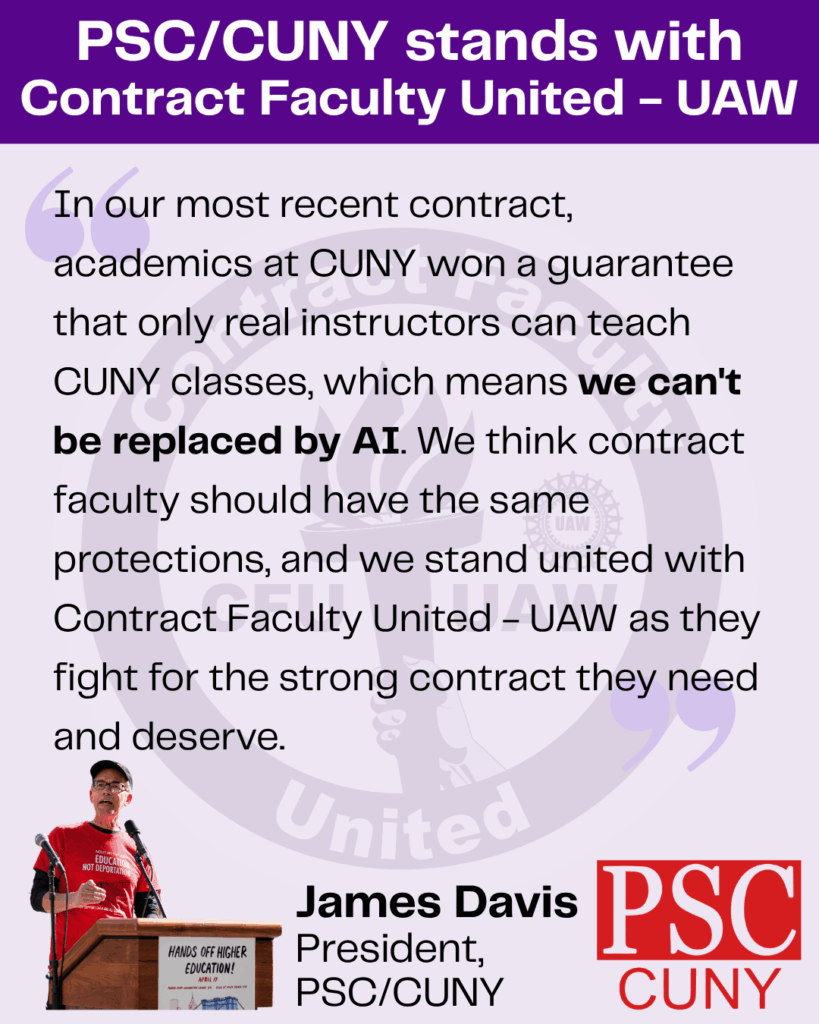 In previous bargaining updates, we noted what has become a trend: faced with the power we wield at the bargaining table, the administration has started making better policy for everyone — and not just on workload relief. On Intellectual Property, we successfully headed off the administration’s attempt to grab massively more of our intellectual property than before. Our legal right to union representation at OEO investigatory meetings led to tenure-track faculty getting parity with us. That trend has continued.
In recent weeks, the administration has announced new university-wide policies expanding bereavement leave and prohibiting bullying. Both of these are in response to our proposals at the bargaining table. While we are pleased to be winning better policy for everyone at NYU, the administration’s posture creates problems: they create and announce a policy, asking us for “input,” which isn’t the same as negotiations. You can see the problem when it comes to our benefits. For the most part the administration has proposed that we receive the same benefits as our tenure-track colleagues, however the administration sees fit to change them at will. An example of this: we have proposed improvements to, among other things, Tuition Remission, Retirement Benefits, and Housing Benefits. Lately, Gigi Dopico has told faculty meetings that she is “looking university-wide” into changing tuition remission, retirement benefits, and mortgage assistance. Good faith bargaining means the administration needs to come to the negotiating table with spelled-out, serious proposals and be willing to negotiate over them: we can’t bargain with hints given in a different forum.
By observing bargaining in person or by zoom, you send an unmistakable message to the administration: that you, alongside 930 of your colleagues, demand fair salaries, academic freedom, job security, and time for your career and your family. The past few weeks have amply proven that when hundreds of contract faculty show up, the administration moves. Let’s keep up the pressure.
In solidarity,
CFU-UAW BARGAINING COMMITTEE
Richard Dorritie (Rory Meyers College of Nursing)
Elisabeth Fay (Expository Writing Program, Arts & Science)
Robin Harvey (Teaching and Learning, Steinhardt)
Thomas Hill (Center for Global Affairs, SPS)
Peter Li (General Engineering, Tandon)
Benedetta Piantella (Technology, Culture, and Society, Tandon)
Jacob Remes (Gallatin School of Individualized Study)
Chris Chan Roberson (Undergraduate Film & TV, Tisch)
Jamie Root (French Literature, Thought and Culture, Arts & Science)
Fanny Shum (Mathematics, Courant Institute)
Heidi White (Liberal Studies)